Use a documented denominator
For the selected PRK24-30 offer, $39 divided by 1200 listed feet is $3.25 per 100 ft. For PRIK24-60, $42.50 divided by 360 nominal feet is about $11.81 per 100 ft. Those are merchandise length costs. They do not establish the same width, texture, grade or protective performance, and the indented-roll tolerance remains relevant.
Keep exact unit conversions
One yard is 3 feet and one foot is 0.3048 meter. A 1200 ft declaration converts to 365.76 m; the corresponding $39 price is about $10.66 per 100 m. These are exact unit relationships applied to a declared length, not a physical measurement of a delivered roll. Keep whether the denominator is nominal, lower-bound or actually measured in the record.
Preserve expanded versus flat feed
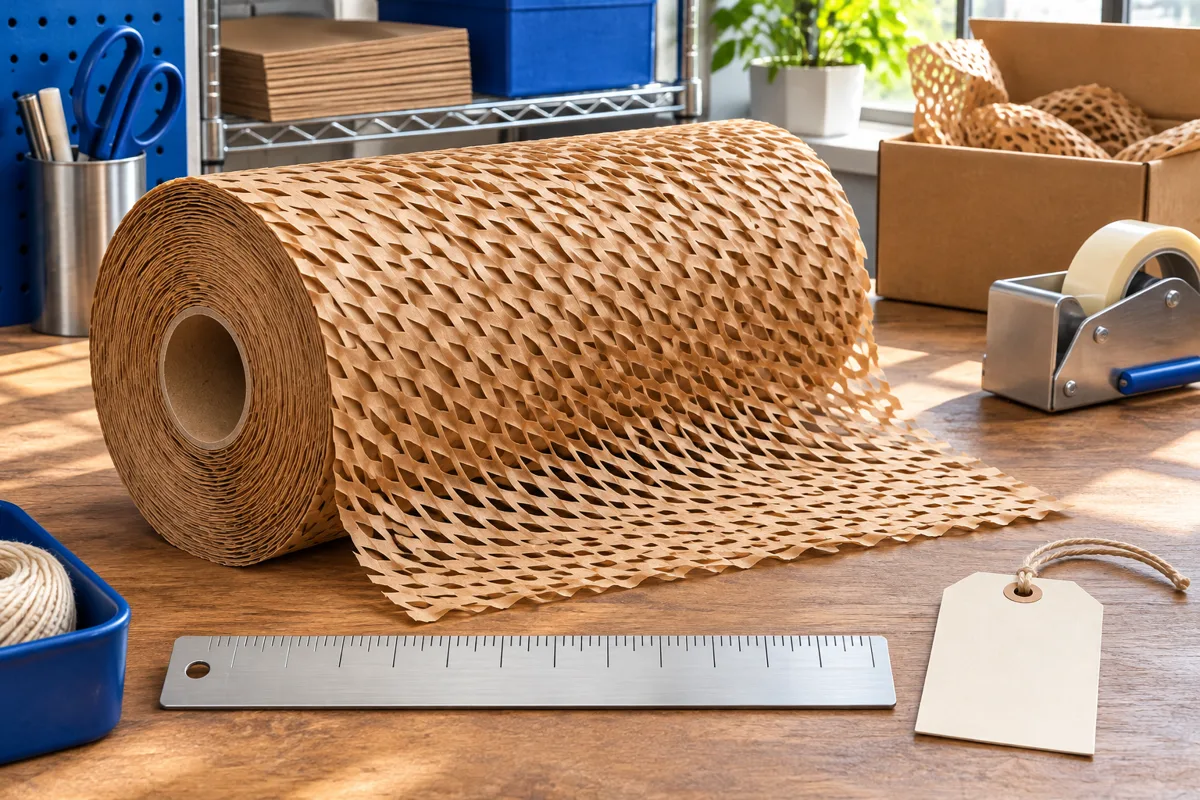
GreenWrap lists 750 expanded feet for the selected case. That can be normalized to meters of expanded length, but it cannot be compared with unexpanded-feed consumption by changing only the unit. Our worksheet keeps a separate basis field and withholds a direct comparison when the two entered bases differ.
Do not rank unlike protection
A lower per-foot amount is not a cheaper completed pack-out until the required amount and suitability are independently established. We have not measured how many feet each material needs for a named product or counted shipping damage. Use the normalized number for purchasing arithmetic while retaining role, width, condition and the actual chosen consumption method beside it.
A yard-based check
The 1200 ft 30#roll contains 400 declared yards because each yard is 3 ft. At 39 dollars, the cost is 9.75 dollars per 100 yards. This is the same price and declared length expressed in another supported unit. Do not compare 9.75 per 100 yards with 3.25 per 100 feet as if they were different offers or savings opportunities.
An expanded-length check
The selected 96-dollar GreenWrap case divided by 750 expanded feet is 12.80 dollars per 100 expanded feet. The basis word is part of the result. It does not describe cost per 100 flat-feed feet, and it does not say how much of another material would be needed to produce a comparable pack-out.
Keep width alongside length cost
A length price alone ignores how wide the selected material is. The compared flat papers list 24 in, and current GreenWrap lists 19 in. This reference does not automatically turn nominal width into usable area or a guaranteed cut plan. Retain the width and its source next to a length comparison instead of hiding it in a cheapest-per-foot headline.
Different consumption is another question
If a hypothetical process used 2 ft of one material and 4 ft of another, its material cost per parcel would depend on those chosen amounts. That example does not establish either as an actual required quantity or a measured equivalent protection result. Obtain a valid process requirement before interpreting the lower unit cost as a lower completed-pack cost.
Add actual charges consistently
To include delivery in a per-length cost, you need the actual order amount and a defensible allocation to the selected material. We have not supplied that allocation or a shipping quote. Do not add one arbitrary freight amount to one offer while ignoring the other and call the comparison a verified delivered-price ranking.
Sources & scope
Checked November 4, 2026. Manufacturer and retailer references support the specific statements. Dated displayed prices are not final checkout quotes, performance rankings or performance testing. This shopping reference does not replace the product label or supplier specifications or relevant configuration testing.
EcoEnclose: selected Kraft Paper Roll variants ↗
Keep reading
A roll, a case and a built-in dispenser are different selling units ↗
Select the paper grade before recording its price ↗
Ships in 1 to 2 business days is not a promised arrival date ↗