Read the full length field
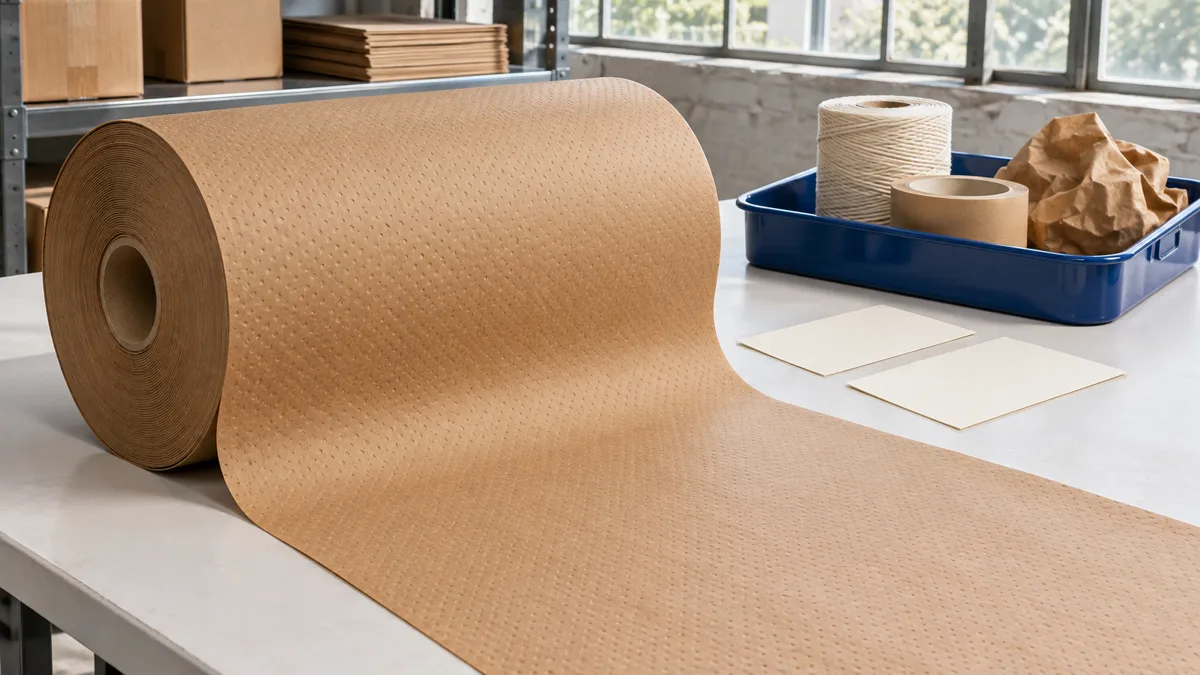
The indented roll product is titled 24 in x 360 ft, but its specifications state 360 plus or minus 30 linear feet. That describes a 330 to 390 ft range around the nominal figure. The title and the tolerance should remain together rather than using 360 as a measured exact content statement for every delivered roll.
Calculate the three denominators
At the observed $42.50, the nominal cost is about $11.81 per 100 ft. At 330 ft it is about $12.88, and at 390 ft about $10.90. These values describe the effect of the published denominator range only. They do not indicate a random measured roll result or guarantee which exact length arrives.
A whole-roll threshold example
For a hypothetical requirement of 350 ft with no matching stock, one nominal 360 ft roll appears sufficient. Using the published 330 ft lower bound would require two whole rolls to cover that chosen length target. That is a purchasing scenario, not a recommendation for protective use or a claim that every order should always double its quantity.
Keep a conservative assumption labeled
Decide which verified length field is appropriate for the planning question and label it clearly. Our planner can use a user-entered conservative length but does not invent a probability distribution or a supplier short-roll policy. If a contractual minimum or exact production requirement matters, ask the seller for the applicable selected-product commitment before ordering.
One roll can cross a threshold
A 350 ft chosen target with no matching stock needs two 330 ft lower-bound rolls but only one 360 ft nominal roll. At 390 ft it also needs one. That difference explains why the tolerance belongs in a whole-roll plan. It does not prove the lower bound is the right contractual assumption for every order; the actual requirement and seller terms matter.
Do not average away the condition
The midpoint 360 ft may be useful for a nominal unit cost, but an exact production minimum can require another basis. This reference has not measured a distribution of delivered lengths and does not assign a likelihood to 330, 360 or 390. No average from a made-up batch is used to justify ordering fewer rolls.
Keep the observed price fixed in the scenario
The 42.50-dollar observation is the same selected roll price in the tolerance examples. Changing the denominator produces the 10.90 to 12.88 per 100 ft range; it does not imply that the seller charged different prices for individual roll lengths. The scenarios explain uncertainty in the declared quantity, not an unobserved dynamic pricing system.
Measured remaining length is another field
A partly used roll can have a privately measured remainder that differs from the original nominal declaration. Mark it as a measurement with a method and date. Do not estimate that remainder from diameter or subtract an invented number of parcels. The planner can use a known length without claiming how it was physically measured.
Ask about the relevant commitment
If a purchase depends on a minimum footage, ask whether the published tolerance applies and what commitment the actual order provides. Keep any response with the selected SKU and date. This site does not invent a return threshold, inspection procedure or warranty remedy from the plus-or-minus notation alone.
Sources & scope
Checked November 4, 2026. Manufacturer and retailer references support the specific statements. Dated displayed prices are not final checkout quotes, performance rankings or performance testing. This shopping reference does not replace the product label or supplier specifications or relevant configuration testing.
Keep reading
A 30# paper grade is not a 30 lb delivered roll ↗
Listed paper width is not a verified usable cut width ↗
Listed unit weight and paper grade must stay in separate columns ↗